Research · 6 September 2026 · BidSkim Limited

An electrical tender is not always an electrical job.

We examined 41 tender records to show what sits behind an electrical search result: the work being purchased, the buying route, the conditions and the usable deadline.

A descriptive pilot covering January–August 2026 publications. These are historical records, not a list of currently open jobs or a representative estimate of the UK market.

What the records described

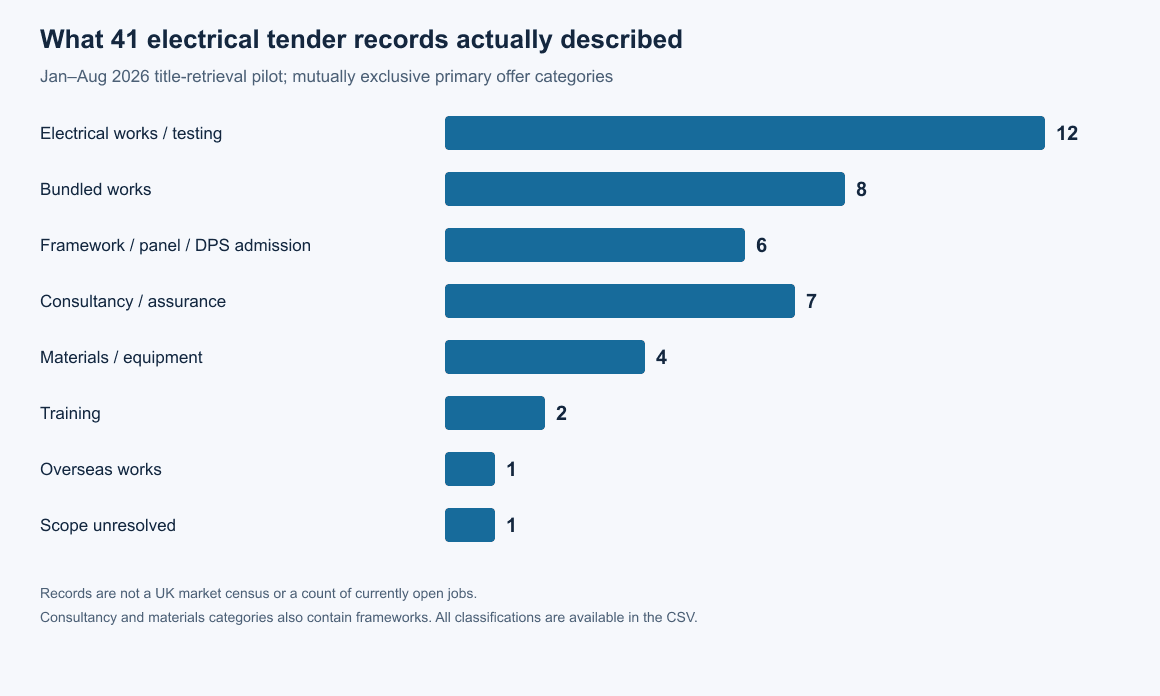
A systematic sample of 41 records from a 203-record title-based retrieval. Categories describe the primary offer, with the reasoning and source link available for every row.

41 records: 12 electrical works or testing, 8 bundled works, 6 framework or panel or DPS admissions, 7 consultancy or assurance, 4 materials or equipment, 2 training, 1 overseas works and 1 unresolved scope.
View the counts as a table
Primary offer categories in the 41-record pilot
Primary offerRecords
Electrical installation, testing or maintenance12
Bundled works8
Framework, supplier-panel or DPS admission6
Consultancy or independent assurance7
Materials or equipment4
Training2
Overseas works1
Scope unresolved1

The twelve electrical-work records include specialist industrial and design-and-build packages. This does not establish suitability for a typical small electrician. Some consultancy and materials records also use frameworks; the six admission records are not an exhaustive framework count.

Five decisions a headline can hide

A £100 million result can be a buying route

YPO’s highway electrical installations publication updates a dynamic purchasing system running from 2019 to 2029. The stated £100 million is the system’s estimated value, not a new job for one contractor. Categories have different entry conditions and lead to subsequent purchasing.

Read the YPO notice

Framework admission is its own competition

Network Rail’s £70 million Eastern Region M&E notice sets a maximum of three framework suppliers. Suppliers first request to participate; the tender stage is invitation-only. Its operating rules then distinguish smaller reactive work, quotations and larger mini-competitions.

Read the Network Rail notice

The package size and service commitment belong together

North Wales Police and Fire’s contractor-list notice describes installation projects capped at £30,000 within a £350,000 whole estimate. Contractors must also provide two-hour response and round-the-clock coverage. A small individual job does not remove the wider service commitment.

Read the North Wales notice

A small value does not settle eligibility

An official publication for Cambridgeshire’s county farm estate testing states £15,000 and expressly requires CHAS accreditation and a qualified electrician or electrical engineer. Parallel records use different procurement identifiers; the pilot does not silently merge them or add their values.

Read the farm estate notice

The practical deadline can come first

The IWM Duxford electrical infrastructure tender required a mandatory visit on 21 July. Its stored Find a Tender submission deadline was 31 July, while the public mirror’s summary displays 1 August. We exclude that conflicting interval from the calculation. The earlier mandatory visit is explicit in the published scope.

Read the Duxford notice
Values describe different scales and terms

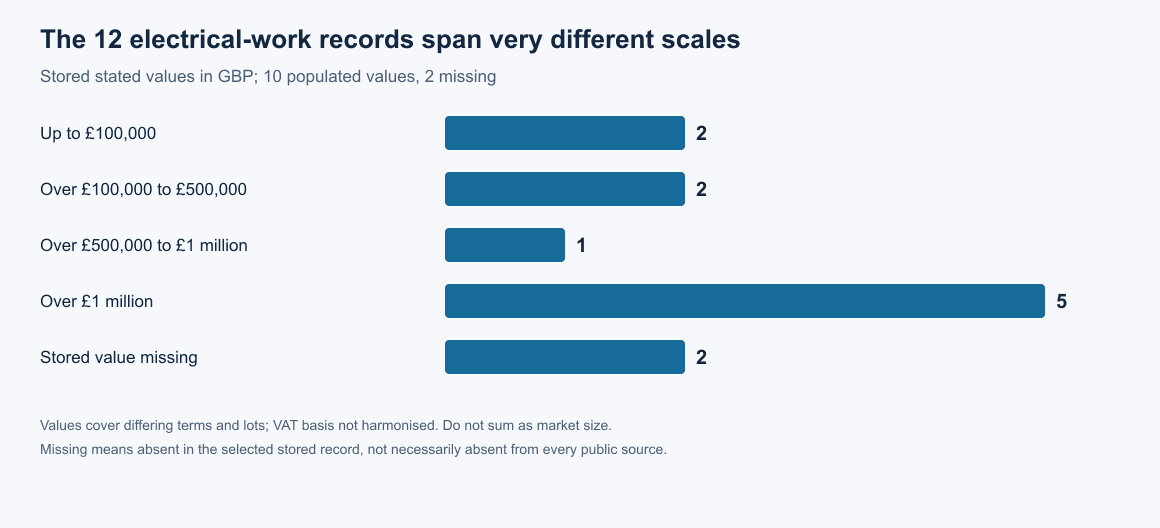
Ten of the twelve electrical-work records had a stored stated value. Values span different contract periods and lots; VAT presentation is not harmonised, so we do not sum them as market size.

Of 12 electrical-work records, 2 have stated values up to £100,000; 2 over £100,000 to £500,000; 1 over £500,000 to £1 million; 5 over £1 million; 2 have no value in the selected stored record.
View the counts as a table
Stored value bands for twelve electrical-work records
Stored stated valueRecords
Up to £100,0002
Over £100,000 to £500,0002
Over £500,000 to £1 million1
Over £1 million5
Missing from selected record2

Missing from a selected record does not mean missing from every public source. The sampled Annalong record had no stored value, while a parallel official notice gives £85,000. Announced contract values are not evidence of money paid.

Recorded deadlines are only part of the picture

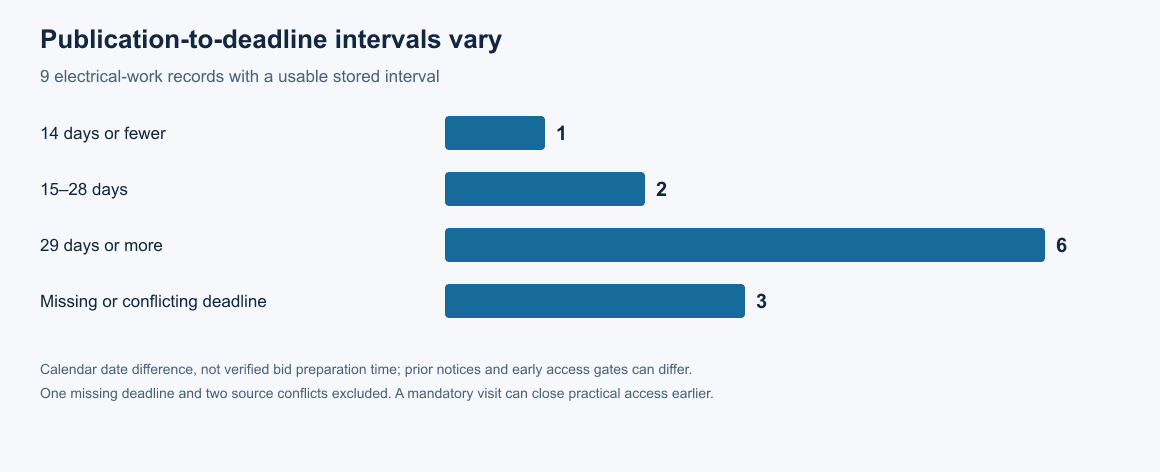
Nine electrical-work records had a stored publication-to-deadline interval without an identified missing or conflicting date. One missing deadline and two source conflicts were excluded.

Among nine usable recorded intervals, one is 14 days or fewer, two are 15 to 28 days and six are 29 days or more. Three other records have a missing or conflicting deadline.
View the counts as a table
Publication-to-deadline intervals and exclusions for twelve electrical-work records
Recorded intervalRecords
14 days or fewer1
15–28 days2
29 days or more6
Missing or conflicting deadline (excluded)3

These are calendar date differences, not verified bid preparation windows. Earlier publications, amendments, site visits and participation stages can change when a contractor needs to act.

Methodology and limits

The evidence was extracted and reviewed on 6 September 2026. Download the method and row-level decisions to check or challenge the findings.

  • Retrieve procurement titles containing electrical, EICR or rewir; select their earliest stored tender-stage notice published from 1 January to 31 August 2026. The retrieval returned 234 notices across 203 procurement records.
  • Order by procurement record identifier and take every fifth record, starting with the first: 41 records. Identifiers can correlate with source and ingestion history. This systematic pilot is not a probability sample and does not estimate national prevalence.
  • Review each selected record’s available full text or description for the purchased scope. Give consultancy, training, goods and overseas work their own categories before distinguishing admission routes, bundled work and electrical packages. Bid-document packs were not examined for every record.
  • A second reviewer checked all 41 category summaries and the full descriptions of 18 electrical-work and admission records. External primary-source corroboration covered 12 selected records, including five deterministic audit selections; coverage ranged from full pages to indexed official sections and parallel notices.
  • Calculate value bands from stated values in the selected records. Missing values stay missing. Calculate date intervals only where a usable stored deadline exists and no conflict was identified; exclude the Greenwich, Pioneer and Duxford cases described in the method.
  • The title selection omits relevant opportunities using other terms. Source coverage, lifecycle duplication and later title changes also affect inclusion. No claim is made about total market size, SME eligibility, buyer discrimination or opportunities a company could have won.

Produced by BidSkim Limited, which sells procurement discovery tools. Public-sector source information is credited to the linked notices. For a correction or a question about the analysis, contact our data desk. We will date substantive corrections on this page.

Electrical opportunity review: a 41-record pilot · BidSkim